Bubble sort
Sorts an array read from the keyboard.
Open in the editor →Sample algorithm, ready to run step by step in your browser. Nothing to install.
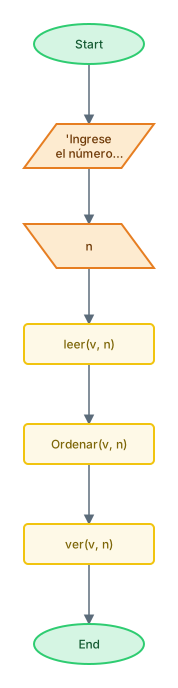
Flowchart
Pseudocode
// Ordenamiento de un vector leído de teclado


Algoritmo main
  // Ordenamiento de un vector leído de teclado

  Escribir 'Ingrese el número de elementos: '
  Leer n
  leer(v, n)
  Ordenar(v, n)
  ver(v, n)
FinAlgoritmo

Funcion ver(v, n)
  // Se muestran los 'n' elementos ordenados del vector

  Escribir 'Elementos ordenados...'
  Para i <- 1 Hasta n
    Escribir v(i)
  FinPara
FinFuncion

Funcion leer(v, n)
  // Se leen de teclado 'n' elementos y se almacenan en el vector 'v'

  Si n != 0
    Escribir ' Ingrese uno a uno los ', n, ' elementos:'
  FinSi
  Para i <- 1 Hasta n
    Leer v(i)
  FinPara
FinFuncion

Funcion Ordenar(v, n)
  // Rutina de ordenamiento de 'n' elementos de un vector

  Para i <- 1 Hasta n-1
    Para j <- i+1 Hasta n
      Si v(i)>v(j)
        temp <- v(i)
        v(i) <- v(j)
        v(j) <- temp
      FinSi
    FinPara
  FinPara
FinFuncion
The same algorithm in Java
package org.desarrollo;

import java.util.ArrayList;
import java.util.Scanner;

/**
 * Ordenamiento de un vector leído de teclado
 */
public class FreeDFDMain {
    /**
     * Ordenamiento de un vector leído de teclado
     *
     * @param args no utilizado — freeDFDWeb no pasa argumentos de línea de comandos.
     */
    public static void main(String[] args) {
        Scanner scanner = new Scanner(System.in);
        double n = 0.0;
        double v = 0.0;

        System.out.println("Ingrese el número de elementos: ");
        n = readDouble(scanner);
        leer(v, n);
        Ordenar(v, n);
        ver(v, n);
    }

    /**
     * Se muestran los 'n' elementos ordenados del vector
     *
     * @param v ArrayList<Double>
     * @param n double
     */
    static void ver(ArrayList<Double> v, double n) {
        double i = 0.0;

        System.out.println("Elementos ordenados...");
        double _forStart1 = 1;
        double _forEnd1 = n;
        double _forStep1 = 1;
        if (_forStep1 == 0) { throw new RuntimeException("El incremento de \"para i\" no puede ser 0"); }
        for (i = _forStart1; _forStep1 > 0 ? i <= _forEnd1 : i >= _forEnd1; i += _forStep1) {
            System.out.println(fmt(vecGet(v, (int)(i))));
        }
    }

    /**
     * Se leen de teclado 'n' elementos y se almacenan en el vector 'v'
     *
     * @param v ArrayList<Double>
     * @param n double
     */
    static void leer(ArrayList<Double> v, double n) {
        double i = 0.0;

        if (((n != 0))) {
            System.out.println(" Ingrese uno a uno los " + fmt(n) + " elementos:");
        }
        double _forStart2 = 1;
        double _forEnd2 = n;
        double _forStep2 = 1;
        if (_forStep2 == 0) { throw new RuntimeException("El incremento de \"para i\" no puede ser 0"); }
        for (i = _forStart2; _forStep2 > 0 ? i <= _forEnd2 : i >= _forEnd2; i += _forStep2) {
            vecSet(v, (int)(i), readDouble(scanner));
        }
    }

    /**
     * Rutina de ordenamiento de 'n' elementos de un vector
     *
     * @param v ArrayList<Double>
     * @param n double
     */
    static void Ordenar(ArrayList<Double> v, double n) {
        double i = 0.0;
        double j = 0.0;
        double temp = 0.0;

        double _forStart3 = 1;
        double _forEnd3 = (n - 1);
        double _forStep3 = 1;
        if (_forStep3 == 0) { throw new RuntimeException("El incremento de \"para i\" no puede ser 0"); }
        for (i = _forStart3; _forStep3 > 0 ? i <= _forEnd3 : i >= _forEnd3; i += _forStep3) {
            double _forStart4 = (i + 1);
            double _forEnd4 = n;
            double _forStep4 = 1;
            if (_forStep4 == 0) { throw new RuntimeException("El incremento de \"para j\" no puede ser 0"); }
            for (j = _forStart4; _forStep4 > 0 ? j <= _forEnd4 : j >= _forEnd4; j += _forStep4) {
                if (((vecGet(v, (int)(i)) > vecGet(v, (int)(j))))) {
                    temp = vecGet(v, (int)(i));
                    vecSet(v, (int)(i), vecGet(v, (int)(j)));
                    vecSet(v, (int)(j), temp);
                }
            }
        }
    }

    static boolean readBoolean(Scanner scanner) {
        String t = scanner.nextLine().trim().toLowerCase();
        if (t.equals("verdadero") || t.equals("true") || t.equals("1")) return true;
        if (t.equals("falso") || t.equals("false") || t.equals("0")) return false;
        throw new RuntimeException("Se esperaba Verdadero o Falso, se recibio: " + t);
    }

    static double readDouble(Scanner scanner) {
        return Double.parseDouble(scanner.nextLine().trim());
    }

    static ArrayList<Double> readVector(Scanner scanner) {
        ArrayList<Double> result = new ArrayList<>();
        for (String token : scanner.nextLine().split(",")) {
            String t = token.trim();
            if (!t.isEmpty()) result.add(Double.parseDouble(t));
        }
        return result;
    }

    /** Formatea un double sin ".0" final cuando es entero — replica cómo freeDFDWeb (JS) imprime números, ej. factorial(5) debe mostrar "120", no "120.0". */
    static String fmt(double d) {
        if (!Double.isInfinite(d) && !Double.isNaN(d) && d == Math.floor(d) && Math.abs(d) < 1e15) {
            return String.valueOf((long) d);
        }
        return String.valueOf(d);
    }

    /** `String.valueOf(true)` da "true" — el pseudolenguaje escribe e imprime "Verdadero"/"Falso". */
    static String boolStr(boolean b) {
        return b ? "Verdadero" : "Falso";
    }

    /** `ToChar(n)` de Flowgorithm: código de carácter → carácter. `Character.toChars` cubre también los puntos fuera del BMP (emoji), que no caben en un `char`. */
    static String toChar(double code) {
        int c = (int) code;
        if (c < 0 || c > 0x10FFFF) {
            throw new RuntimeException("ToChar(" + c + "): codigo de caracter fuera de rango");
        }
        return new String(Character.toChars(c));
    }

    /** `ToFixed(r, i)` de Flowgorithm: TRUNCA a `i` decimales, no redondea. `Locale.ROOT` para que el separador sea el punto siempre, igual que el resto del generador. */
    static String toFixed(double value, double digits) {
        int d = (int) digits;
        double factor = Math.pow(10, d);
        double truncated = (double)(long)(value * factor) / factor;
        return String.format(java.util.Locale.ROOT, "%." + d + "f", truncated);
    }

    static double vecGet(ArrayList<Double> v, int index) {
        int i = index - 1;
        if (i < 0 || i >= v.size() || v.get(i) == null) {
            throw new RuntimeException("La posición " + index + " del vector no tiene un valor asignado todavía");
        }
        return v.get(i);
    }

    static void vecSet(ArrayList<Double> v, int index, double value) {
        int i = index - 1;
        while (v.size() <= i) v.add(null);
        v.set(i, value);
    }

    static double div(double a, double b) {
        if (b == 0) throw new ArithmeticException("División por cero");
        return a / b;
    }

    static double mod(double a, double b) {
        if (b == 0) throw new ArithmeticException("Módulo por cero");
        return a % b;
    }

    static void sleep(double seconds) {
        try { Thread.sleep((long) (seconds * 1000)); } catch (InterruptedException e) { Thread.currentThread().interrupt(); }
    }
}
The same algorithm in Python
#!/usr/bin/env python3
"""Ordenamiento de un vector leído de teclado"""
import math
import random
import sys
import time
import datetime


class DfdRuntimeError(Exception):
    pass


def read_boolean():
    t = input().strip().lower()
    if t in ('verdadero', 'true', '1'):
        return True
    if t in ('falso', 'false', '0'):
        return False
    raise DfdRuntimeError('Se esperaba Verdadero o Falso, se recibio: ' + t)


def read_double():
    return float(input().strip())


def read_vector():
    return [float(t.strip()) for t in input().split(',') if t.strip() != '']


def fmt(d):
    """Formatea sin ".0" final cuando es entero — replica cómo freeDFDWeb (JS) imprime números."""
    if math.isinf(d):
        return 'Infinity' if d > 0 else '-Infinity'
    if math.isnan(d):
        return 'NaN'
    if d == math.floor(d) and abs(d) < 1e15:
        return str(int(d))
    return str(d)


def bool_str(b):
    """`str(True)` da "True" (mayúscula) — el pseudolenguaje escribe e imprime "Verdadero"/"Falso"."""
    return 'Verdadero' if b else 'Falso'


def sgn(x):
    """`Sgn(n)` de Flowgorithm. Devuelve x tal cual en el cero para conservar el signo del -0.0, igual que `Math.sign` de JS."""
    if math.isnan(x):
        return x
    if x > 0:
        return 1.0
    if x < 0:
        return -1.0
    return x


def to_fixed(value, digits):
    """`ToFixed(r, i)` de Flowgorithm: TRUNCA a i decimales, no redondea."""
    d = int(digits)
    factor = 10 ** d
    truncated = math.trunc(value * factor) / factor
    return f'{truncated:.{d}f}'


def vec_get(v, index):
    i = index - 1
    if i < 0 or i >= len(v) or v[i] is None:
        raise DfdRuntimeError(f'La posición {index} del vector no tiene un valor asignado todavía')
    return v[i]


def vec_set(v, index, value):
    i = index - 1
    while len(v) <= i:
        v.append(None)
    v[i] = value


def div(a, b):
    if b == 0:
        raise DfdRuntimeError('División por cero')
    return a / b


def mod(a, b):
    if b == 0:
        raise DfdRuntimeError('Módulo por cero')
    # `math.fmod`, NUNCA el `%` nativo de Python — el signo del resultado de
    # `%` en Python sigue al DIVISOR (-7 % 3 == 2), mientras que JS (y el
    # intérprete real) usan resto con signo del DIVIDENDO (-7 % 3 == -1),
    # que es exactamente lo que `math.fmod` reproduce.
    return math.fmod(a, b)


def redon(x):
    """Redondeo tipo `Math.round` de JS (.5 siempre hacia +Infinity) — NUNCA `round()` nativo de Python (redondeo bancario: round(2.5) == 2)."""
    return math.floor(x + 0.5)


def ver(v, n):
    """
    Se muestran los 'n' elementos ordenados del vector

    Args:
        v: list[float]
        n: float
    """
    print("Elementos ordenados...")
    _for_start_1 = 1
    _for_end_1 = n
    _for_step_1 = 1
    if _for_step_1 == 0:
        raise DfdRuntimeError('El incremento de "para i" no puede ser 0')
    i = _for_start_1
    while (i <= _for_end_1) if _for_step_1 > 0 else (i >= _for_end_1):
        print(fmt(vec_get(v, int(i))))
        i += _for_step_1

def leer(v, n):
    """
    Se leen de teclado 'n' elementos y se almacenan en el vector 'v'

    Args:
        v: list[float]
        n: float
    """
    if (n != 0):
        print(" Ingrese uno a uno los " + fmt(n) + " elementos:")
    _for_start_2 = 1
    _for_end_2 = n
    _for_step_2 = 1
    if _for_step_2 == 0:
        raise DfdRuntimeError('El incremento de "para i" no puede ser 0')
    i = _for_start_2
    while (i <= _for_end_2) if _for_step_2 > 0 else (i >= _for_end_2):
        vec_set(v, int(i), read_double())
        i += _for_step_2

def Ordenar(v, n):
    """
    Rutina de ordenamiento de 'n' elementos de un vector

    Args:
        v: list[float]
        n: float
    """
    _for_start_3 = 1
    _for_end_3 = (n - 1)
    _for_step_3 = 1
    if _for_step_3 == 0:
        raise DfdRuntimeError('El incremento de "para i" no puede ser 0')
    i = _for_start_3
    while (i <= _for_end_3) if _for_step_3 > 0 else (i >= _for_end_3):
        _for_start_4 = (i + 1)
        _for_end_4 = n
        _for_step_4 = 1
        if _for_step_4 == 0:
            raise DfdRuntimeError('El incremento de "para j" no puede ser 0')
        j = _for_start_4
        while (j <= _for_end_4) if _for_step_4 > 0 else (j >= _for_end_4):
            if (vec_get(v, int(i)) > vec_get(v, int(j))):
                temp = vec_get(v, int(i))
                vec_set(v, int(i), vec_get(v, int(j)))
                vec_set(v, int(j), temp)
            j += _for_step_4
        i += _for_step_3

def main():
    """Ordenamiento de un vector leído de teclado"""
    print("Ingrese el número de elementos: ")
    n = read_double()
    leer(v, n)
    Ordenar(v, n)
    ver(v, n)


if __name__ == '__main__':
    main()
The same algorithm in C#
using System;
using System.Collections.Generic;
using System.Globalization;

/// <summary>Excepción propia para errores de ejecución del programa generado (división por cero, índice de vector sin asignar, etc.) — mismo criterio que el `RuntimeError` real de freeDFDWeb.</summary>
class DfdRuntimeException : Exception {
    public DfdRuntimeException(string message) : base(message) { }
}

/// <summary>
/// Ordenamiento de un vector leído de teclado
/// </summary>
class Program {
    /// <summary>
    /// Ordenamiento de un vector leído de teclado
    /// </summary>
    /// <param name="args">no utilizado — freeDFDWeb no pasa argumentos de línea de comandos.</param>
    static void Main(string[] args) {
        CultureInfo.CurrentCulture = CultureInfo.InvariantCulture;
        double n = 0.0;
        double v = 0.0;

        Console.WriteLine("Ingrese el número de elementos: ");
        n = ReadDouble();
        leer(v, n);
        Ordenar(v, n);
        ver(v, n);
    }

    /// <summary>
    /// Se muestran los 'n' elementos ordenados del vector
    /// </summary>
    /// <param name="v">List<double?></param>
    /// <param name="n">double</param>
    static void ver(List<double?> v, double n) {
        double i = 0.0;

        Console.WriteLine("Elementos ordenados...");
        double _forStart1 = 1;
        double _forEnd1 = n;
        double _forStep1 = 1;
        if (_forStep1 == 0) { throw new DfdRuntimeException("El incremento de \"para i\" no puede ser 0"); }
        for (i = _forStart1; _forStep1 > 0 ? i <= _forEnd1 : i >= _forEnd1; i += _forStep1) {
            Console.WriteLine(Fmt(VecGet(v, (int)(i))));
        }
    }

    /// <summary>
    /// Se leen de teclado 'n' elementos y se almacenan en el vector 'v'
    /// </summary>
    /// <param name="v">List<double?></param>
    /// <param name="n">double</param>
    static void leer(List<double?> v, double n) {
        double i = 0.0;

        if ((n != 0)) {
            Console.WriteLine(" Ingrese uno a uno los " + Fmt(n) + " elementos:");
        }
        double _forStart2 = 1;
        double _forEnd2 = n;
        double _forStep2 = 1;
        if (_forStep2 == 0) { throw new DfdRuntimeException("El incremento de \"para i\" no puede ser 0"); }
        for (i = _forStart2; _forStep2 > 0 ? i <= _forEnd2 : i >= _forEnd2; i += _forStep2) {
            VecSet(v, (int)(i), ReadDouble());
        }
    }

    /// <summary>
    /// Rutina de ordenamiento de 'n' elementos de un vector
    /// </summary>
    /// <param name="v">List<double?></param>
    /// <param name="n">double</param>
    static void Ordenar(List<double?> v, double n) {
        double i = 0.0;
        double j = 0.0;
        double temp = 0.0;

        double _forStart3 = 1;
        double _forEnd3 = (n - 1);
        double _forStep3 = 1;
        if (_forStep3 == 0) { throw new DfdRuntimeException("El incremento de \"para i\" no puede ser 0"); }
        for (i = _forStart3; _forStep3 > 0 ? i <= _forEnd3 : i >= _forEnd3; i += _forStep3) {
            double _forStart4 = (i + 1);
            double _forEnd4 = n;
            double _forStep4 = 1;
            if (_forStep4 == 0) { throw new DfdRuntimeException("El incremento de \"para j\" no puede ser 0"); }
            for (j = _forStart4; _forStep4 > 0 ? j <= _forEnd4 : j >= _forEnd4; j += _forStep4) {
                if ((VecGet(v, (int)(i)) > VecGet(v, (int)(j)))) {
                    temp = VecGet(v, (int)(i));
                    VecSet(v, (int)(i), VecGet(v, (int)(j)));
                    VecSet(v, (int)(j), temp);
                }
            }
        }
    }

    static readonly Random Rnd = new Random();

    static bool ReadBoolean() {
        string t = (Console.ReadLine() ?? "").Trim().ToLowerInvariant();
        if (t == "verdadero" || t == "true" || t == "1") return true;
        if (t == "falso" || t == "false" || t == "0") return false;
        throw new Exception("Se esperaba Verdadero o Falso, se recibio: " + t);
    }

    static double ReadDouble() {
        return double.Parse(Console.ReadLine().Trim(), CultureInfo.InvariantCulture);
    }

    static List<double?> ReadVector() {
        List<double?> result = new List<double?>();
        foreach (string token in Console.ReadLine().Split(',')) {
            string t = token.Trim();
            if (t.Length > 0) result.Add(double.Parse(t, CultureInfo.InvariantCulture));
        }
        return result;
    }

    /// <summary>Formatea un double sin ".0" final cuando es entero — replica cómo freeDFDWeb (JS) imprime números.</summary>
    static string Fmt(double d) {
        if (double.IsPositiveInfinity(d)) return "Infinity";
        if (double.IsNegativeInfinity(d)) return "-Infinity";
        if (double.IsNaN(d)) return "NaN";
        if (d == Math.Floor(d) && Math.Abs(d) < 1e15) {
            return ((long)d).ToString(CultureInfo.InvariantCulture);
        }
        return d.ToString(CultureInfo.InvariantCulture);
    }

    /// <summary>`true.ToString()` da "True" (mayúscula) — el pseudolenguaje escribe e imprime "Verdadero"/"Falso".</summary>
    static string BoolStr(bool b) {
        return b ? "Verdadero" : "Falso";
    }

    /// <summary>`Sgn(n)` de Flowgorithm. Helper y no `Math.Sign`: ese LANZA sobre NaN, mientras el intérprete devuelve NaN. Devuelve x en el cero para conservar el -0.0.</summary>
    static double Sgn(double x) {
        if (double.IsNaN(x)) return x;
        if (x > 0) return 1.0;
        if (x < 0) return -1.0;
        return x;
    }

    /// <summary>`ToFixed(r, i)` de Flowgorithm: TRUNCA a i decimales, no redondea. `InvariantCulture` para que el separador sea el punto, igual que `Fmt`.</summary>
    static string ToFixed(double value, double digits) {
        int d = (int) digits;
        double factor = Math.Pow(10, d);
        double truncated = Math.Truncate(value * factor) / factor;
        return truncated.ToString("F" + d, CultureInfo.InvariantCulture);
    }

    static double VecGet(List<double?> v, int index) {
        int i = index - 1;
        if (i < 0 || i >= v.Count || !v[i].HasValue) {
            throw new DfdRuntimeException("La posición " + index + " del vector no tiene un valor asignado todavía");
        }
        return v[i].Value;
    }

    static void VecSet(List<double?> v, int index, double value) {
        int i = index - 1;
        while (v.Count <= i) v.Add(null);
        v[i] = value;
    }

    static double Div(double a, double b) {
        if (b == 0) throw new DfdRuntimeException("División por cero");
        return a / b;
    }

    static double Mod(double a, double b) {
        if (b == 0) throw new DfdRuntimeException("Módulo por cero");
        // El operador `%` nativo de C# para `double` SÍ coincide con el
        // signo de JS (confirmado real: -7 % 3 == -1 en ambos) — a
        // diferencia de Python, no hace falta ningún wrapper de signo.
        return a % b;
    }

    /// <summary>Redondeo tipo `Math.round` de JS (.5 siempre hacia +Infinity) — NUNCA `Math.Round()` directo (bancario en .NET: Math.Round(2.5) == 2).</summary>
    static double Redon(double x) {
        return Math.Floor(x + 0.5);
    }
}
The same algorithm in C++
#include <iostream>
#include <string>
#include <vector>
#include <optional>
#include <cmath>
#include <sstream>
#include <iomanip>
#include <algorithm>
#include <cstdlib>
#include <ctime>
#include <chrono>
#include <thread>
#include <charconv>
#include <stdexcept>

/**
 * Ordenamiento de un vector leído de teclado
 */

const double PI = 3.14159265358979323846;

class DfdRuntimeError : public std::runtime_error {
public:
    explicit DfdRuntimeError(const std::string& message) : std::runtime_error(message) {}
};

std::string readLine() {
    std::string line;
    if (!std::getline(std::cin, line)) return "";
    if (!line.empty() && line.back() == '\r') line.pop_back();
    return line;
}

/** `std::stod` (usado por `toNumberOrThrow`) NO tira con texto no numérico de forma consistente en todos los casos (ignora sufijos raros) pero SÍ tira `std::invalid_argument` con texto totalmente no numérico — verificado real. Envuelto para relanzar como `DfdRuntimeError`, mismo tipo de excepción que el resto del programa generado. */
double toNumberOrThrow(const std::string& value) {
    try {
        return std::stod(value);
    } catch (const std::exception&) {
        throw DfdRuntimeError("Se esperaba un número, se encontró \"" + value + "\"");
    }
}

bool readBoolean() {
    std::string t = readLine();
    for (auto& c : t) c = (char)std::tolower((unsigned char)c);
    if (t == "verdadero" || t == "true" || t == "1") return true;
    if (t == "falso" || t == "false" || t == "0") return false;
    throw std::runtime_error("Se esperaba Verdadero o Falso, se recibio: " + t);
}

double readDouble() {
    return toNumberOrThrow(readLine());
}

std::vector<std::optional<double>> readVector() {
    std::vector<std::optional<double>> result;
    std::stringstream ss(readLine());
    std::string token;
    while (std::getline(ss, token, ',')) {
        size_t start = token.find_first_not_of(" \t");
        size_t end = token.find_last_not_of(" \t");
        if (start == std::string::npos) continue;
        result.push_back(toNumberOrThrow(token.substr(start, end - start + 1)));
    }
    return result;
}

/** Formatea sin ".0" final cuando es entero, con representación de ida y vuelta exacta para decimales (`std::to_chars`, C++17) — replica cómo freeDFDWeb (JS) imprime números. Diverge de JS solo en notación científica de magnitudes extremas (ver comentario de cabecera del archivo), gap aceptado. */
std::string fmt(double d) {
    if (std::isinf(d)) return d > 0 ? "Infinity" : "-Infinity";
    if (std::isnan(d)) return "NaN";
    char buf[64];
    if (d == std::floor(d) && std::abs(d) < 1e15) {
        auto res = std::to_chars(buf, buf + sizeof(buf), (long long)d);
        return std::string(buf, res.ptr);
    }
    auto res = std::to_chars(buf, buf + sizeof(buf), d);
    return std::string(buf, res.ptr);
}

/** `std::cout << bool` imprime "1"/"0" — el pseudolenguaje escribe e imprime "Verdadero"/"Falso". */
std::string boolStr(bool b) {
    return b ? "Verdadero" : "Falso";
}

/** `Sgn(n)` de Flowgorithm. Devuelve x en el cero para conservar el signo del -0.0, igual que `Math.sign` de JS. */
double sgn(double x) {
    if (std::isnan(x)) return x;
    if (x > 0) return 1.0;
    if (x < 0) return -1.0;
    return x;
}

/** `ToChar(n)`: punto de código → carácter. C++ es el único destino sin conversión nativa, así que codifica UTF-8 a mano — `std::string` acá son bytes, no puntos de código. */
std::string toCharStr(double code) {
    long long c = (long long) code;
    if (c < 0 || c > 0x10FFFF) {
        throw DfdRuntimeError("ToChar(" + std::to_string(c) + "): codigo de caracter fuera de rango");
    }
    std::string out;
    if (c < 0x80) {
        out += (char)c;
    } else if (c < 0x800) {
        out += (char)(0xC0 | (c >> 6));
        out += (char)(0x80 | (c & 0x3F));
    } else if (c < 0x10000) {
        out += (char)(0xE0 | (c >> 12));
        out += (char)(0x80 | ((c >> 6) & 0x3F));
        out += (char)(0x80 | (c & 0x3F));
    } else {
        out += (char)(0xF0 | (c >> 18));
        out += (char)(0x80 | ((c >> 12) & 0x3F));
        out += (char)(0x80 | ((c >> 6) & 0x3F));
        out += (char)(0x80 | (c & 0x3F));
    }
    return out;
}

/** `ToCode(c)`: inversa de `toCharStr` — decodifica el PRIMER punto de código UTF-8, no el primer byte (si no, una "ñ" daría 195). */
double toCode(const std::string& s) {
    if (s.empty()) {
        throw DfdRuntimeError("ToCode espera un texto de un caracter");
    }
    unsigned char b0 = (unsigned char)s[0];
    if (b0 < 0x80) return (double)b0;
    int extra = (b0 >= 0xF0) ? 3 : (b0 >= 0xE0) ? 2 : 1;
    long long cp = b0 & (0x3F >> extra);
    for (int i = 1; i <= extra; i++) {
        if ((size_t)i >= s.size()) {
            throw DfdRuntimeError("ToCode: texto UTF-8 mal formado");
        }
        cp = (cp << 6) | ((unsigned char)s[i] & 0x3F);
    }
    return (double)cp;
}

/** `ToFixed(r, i)` de Flowgorithm: TRUNCA a i decimales, no redondea. */
std::string toFixed(double value, double digits) {
    int d = (int) digits;
    double factor = std::pow(10.0, d);
    double truncated = std::trunc(value * factor) / factor;
    std::ostringstream out;
    out << std::fixed << std::setprecision(d) << truncated;
    return out.str();
}

std::string toUpperStr(const std::string& s) {
    std::string result = s;
    std::transform(result.begin(), result.end(), result.begin(), [](unsigned char c) { return std::toupper(c); });
    return result;
}

std::string toLowerStr(const std::string& s) {
    std::string result = s;
    std::transform(result.begin(), result.end(), result.begin(), [](unsigned char c) { return std::tolower(c); });
    return result;
}

double vecGet(std::vector<std::optional<double>>& v, int index) {
    int i = index - 1;
    if (i < 0 || (size_t)i >= v.size() || !v[i].has_value()) {
        throw DfdRuntimeError("La posición " + std::to_string(index) + " del vector no tiene un valor asignado todavía");
    }
    return *v[i];
}

void vecSet(std::vector<std::optional<double>>& v, int index, double value) {
    int i = index - 1;
    if ((size_t)(i + 1) > v.size()) v.resize(i + 1);
    v[i] = value;
}

/**
 * `dividir` y no `div`, que sería el nombre obvio: `div` YA EXISTE en la
 * biblioteca estándar de C (`<cstdlib>`, devuelve un `div_t`) y está
 * declarada aunque no se incluya ese encabezado. Con dos literales
 * enteros, `div(7, 2)` resuelve a la versión de C —coincidencia exacta—
 * y el programa generado NO COMPILA:
 *
 *     error: cannot convert 'div_t' to 'double'
 *
 * O sea: CUALQUIER programa con una división fallaba al exportar a C++.
 * Encontrado el 30-oct-2026 compilando de verdad lo exportado
 * (`scripts/equivalencia/comparar.mjs`); ninguna prueba lo veía porque
 * ninguna compilaba C++.
 */
double dividir(double a, double b) {
    if (b == 0) throw DfdRuntimeError("División por cero");
    return a / b;
}

double mod(double a, double b) {
    if (b == 0) throw DfdRuntimeError("Módulo por cero");
    // `%` NO COMPILA sobre `double` en C++ — `std::fmod` es la única forma.
    // Su signo SÍ coincide con JS (confirmado real), a diferencia de
    // Python, que necesitaba un wrapper de signo además del de cero.
    return std::fmod(a, b);
}

/** Redondeo tipo `Math.round` de JS (.5 siempre hacia +Infinity) — NUNCA `std::round()` directo (redondea siempre alejándose de cero: round(-2.5) == -3, distinto de Math.round(-2.5) == -2). */
double redon(double x) {
    return std::floor(x + 0.5);
}

// ---------------------------------------------------------------------------
// Programa
// ---------------------------------------------------------------------------

/**
 * Se muestran los 'n' elementos ordenados del vector
 * @param v std::vector<std::optional<double>>
 * @param n double
 */
void ver(std::vector<std::optional<double>> v, double n) {
    double i = 0.0;

    std::cout << std::string("Elementos ordenados...") << "\n";
    double _forStart1 = 1;
    double _forEnd1 = n;
    double _forStep1 = 1;
    if (_forStep1 == 0) { throw DfdRuntimeError("El incremento de \"para i\" no puede ser 0"); }
    for (i = _forStart1; _forStep1 > 0 ? i <= _forEnd1 : i >= _forEnd1; i += _forStep1) {
        std::cout << fmt(vecGet(v, (int)(i))) << "\n";
    }
}

/**
 * Se leen de teclado 'n' elementos y se almacenan en el vector 'v'
 * @param v std::vector<std::optional<double>>
 * @param n double
 */
void leer(std::vector<std::optional<double>> v, double n) {
    double i = 0.0;

    if ((n != 0)) {
        std::cout << std::string(" Ingrese uno a uno los ") + fmt(n) + std::string(" elementos:") << "\n";
    }
    double _forStart2 = 1;
    double _forEnd2 = n;
    double _forStep2 = 1;
    if (_forStep2 == 0) { throw DfdRuntimeError("El incremento de \"para i\" no puede ser 0"); }
    for (i = _forStart2; _forStep2 > 0 ? i <= _forEnd2 : i >= _forEnd2; i += _forStep2) {
        vecSet(v, (int)(i), readDouble());
    }
}

/**
 * Rutina de ordenamiento de 'n' elementos de un vector
 * @param v std::vector<std::optional<double>>
 * @param n double
 */
void Ordenar(std::vector<std::optional<double>> v, double n) {
    double i = 0.0;
    double j = 0.0;
    double temp = 0.0;

    double _forStart3 = 1;
    double _forEnd3 = (n - 1);
    double _forStep3 = 1;
    if (_forStep3 == 0) { throw DfdRuntimeError("El incremento de \"para i\" no puede ser 0"); }
    for (i = _forStart3; _forStep3 > 0 ? i <= _forEnd3 : i >= _forEnd3; i += _forStep3) {
        double _forStart4 = (i + 1);
        double _forEnd4 = n;
        double _forStep4 = 1;
        if (_forStep4 == 0) { throw DfdRuntimeError("El incremento de \"para j\" no puede ser 0"); }
        for (j = _forStart4; _forStep4 > 0 ? j <= _forEnd4 : j >= _forEnd4; j += _forStep4) {
            if ((vecGet(v, (int)(i)) > vecGet(v, (int)(j)))) {
                temp = vecGet(v, (int)(i));
                vecSet(v, (int)(i), vecGet(v, (int)(j)));
                vecSet(v, (int)(j), temp);
            }
        }
    }
}

/**
 * Ordenamiento de un vector leído de teclado
 */
int main() {
    double n = 0.0;
    double v = 0.0;

    std::cout << std::string("Ingrese el número de elementos: ") << "\n";
    n = readDouble();
    leer(v, n);
    Ordenar(v, n);
    ver(v, n);
    return 0;
}
The same algorithm in TypeScript
import * as fs from 'fs';

/**
 * Ordenamiento de un vector leído de teclado
 */

class DfdRuntimeError extends Error {}

const inputLines: string[] = fs.readFileSync(0, 'utf-8').split('\n');
let inputIndex = 0;

/** Toda la entrada se lee de una sola vez al arrancar (ver cabecera del archivo) — cada llamada consume la siguiente línea ya bufferizada. */
function readLine(): string {
    return (inputLines[inputIndex++] ?? '').replace(/\r$/, '');
}

function readBoolean(): boolean {
    const t = readLine().trim().toLowerCase();
    if (t === 'verdadero' || t === 'true' || t === '1') return true;
    if (t === 'falso' || t === 'false' || t === '0') return false;
    throw new Error('Se esperaba Verdadero o Falso, se recibio: ' + t);
}

function readDouble(): number {
    return toNumberOrThrow(readLine().trim());
}

function readVector(): (number | undefined)[] {
    return readLine()
        .split(',')
        .map((t) => t.trim())
        .filter((t) => t.length > 0)
        .map((t) => toNumberOrThrow(t));
}

/** `Number(x)` nativo no tira error con texto no numérico (da `NaN`) — a diferencia del intérprete real (`toNumber`), que sí tira. Único punto donde este generador necesita reproducir ese comportamiento a mano. */
function toNumberOrThrow(value: string | number): number {
    const n = Number(value);
    if (Number.isNaN(n)) {
        throw new DfdRuntimeError(`Se esperaba un número, se encontró "${value}"`);
    }
    return n;
}

/** `String(true)` da "true" — el pseudolenguaje escribe e imprime "Verdadero"/"Falso". */
function boolStr(b: boolean): string {
    return b ? 'Verdadero' : 'Falso';
}

/** `ToFixed(r, i)` de Flowgorithm: TRUNCA a i decimales, no redondea — por eso no basta el `.toFixed()` nativo, que redondea. */
function toFixed(value: number, digits: number): string {
    const d = Math.trunc(digits);
    const factor = Math.pow(10, d);
    return (Math.trunc(value * factor) / factor).toFixed(d);
}

function vecGet(v: (number | undefined)[], index: number): number {
    const i = Math.trunc(index) - 1;
    const value = v[i];
    if (i < 0 || value === undefined) {
        throw new DfdRuntimeError(`La posición ${index} del vector no tiene un valor asignado todavía`);
    }
    return value;
}

function vecSet(v: (number | undefined)[], index: number, value: number): void {
    v[Math.trunc(index) - 1] = value;
}

function div(a: number, b: number): number {
    if (b === 0) throw new DfdRuntimeError('División por cero');
    return a / b;
}

function mod(a: number, b: number): number {
    if (b === 0) throw new DfdRuntimeError('Módulo por cero');
    // El `%` nativo de JS/TS coincide exacto con el del intérprete real
    // (mismo motor) — a diferencia de Python, no hace falta ningún wrapper
    // de signo, solo el chequeo de división por cero.
    return a % b;
}


/**
 * Se muestran los 'n' elementos ordenados del vector
 * @param v (number | undefined)[]
 * @param n number
 */
function ver(v: (number | undefined)[], n: number): void {
    let i: number = 0;

    console.log("Elementos ordenados...");
    const _forStart1 = 1;
    const _forEnd1 = n;
    const _forStep1 = 1;
    if (_forStep1 === 0) { throw new DfdRuntimeError("El incremento de \"para i\" no puede ser 0"); }
    for (i = _forStart1; _forStep1 > 0 ? i <= _forEnd1 : i >= _forEnd1; i += _forStep1) {
        console.log(String(vecGet(v, i)));
    }
}

/**
 * Se leen de teclado 'n' elementos y se almacenan en el vector 'v'
 * @param v (number | undefined)[]
 * @param n number
 */
function leer(v: (number | undefined)[], n: number): void {
    let i: number = 0;

    if ((n !== 0)) {
        console.log(" Ingrese uno a uno los " + String(n) + " elementos:");
    }
    const _forStart2 = 1;
    const _forEnd2 = n;
    const _forStep2 = 1;
    if (_forStep2 === 0) { throw new DfdRuntimeError("El incremento de \"para i\" no puede ser 0"); }
    for (i = _forStart2; _forStep2 > 0 ? i <= _forEnd2 : i >= _forEnd2; i += _forStep2) {
        vecSet(v, i, readDouble());
    }
}

/**
 * Rutina de ordenamiento de 'n' elementos de un vector
 * @param v (number | undefined)[]
 * @param n number
 */
function Ordenar(v: (number | undefined)[], n: number): void {
    let i: number = 0;
    let j: number = 0;
    let temp: number = 0;

    const _forStart3 = 1;
    const _forEnd3 = (n - 1);
    const _forStep3 = 1;
    if (_forStep3 === 0) { throw new DfdRuntimeError("El incremento de \"para i\" no puede ser 0"); }
    for (i = _forStart3; _forStep3 > 0 ? i <= _forEnd3 : i >= _forEnd3; i += _forStep3) {
        const _forStart4 = (i + 1);
        const _forEnd4 = n;
        const _forStep4 = 1;
        if (_forStep4 === 0) { throw new DfdRuntimeError("El incremento de \"para j\" no puede ser 0"); }
        for (j = _forStart4; _forStep4 > 0 ? j <= _forEnd4 : j >= _forEnd4; j += _forStep4) {
            if ((vecGet(v, i) > vecGet(v, j))) {
                temp = vecGet(v, i);
                vecSet(v, i, vecGet(v, j));
                vecSet(v, j, temp);
            }
        }
    }
}

/**
 * Ordenamiento de un vector leído de teclado
 */
function main(): void {
    let n: number = 0;
    let v: number = 0;

    console.log("Ingrese el número de elementos: ");
    n = readDouble();
    leer(v, n);
    Ordenar(v, n);
    ver(v, n);
}

main();
Generated by freeDFDWeb from the flowchart above. It is the same file the editor’s Export button downloads.
Opens and saves the formats you already use
Imports and exports PSeInt (.psc) and Flowgorithm (.fprg), and opens .dfd files from classic DFD. All in the browser, nothing to install: works on Windows, Mac, Linux, Chromebook and phones.